
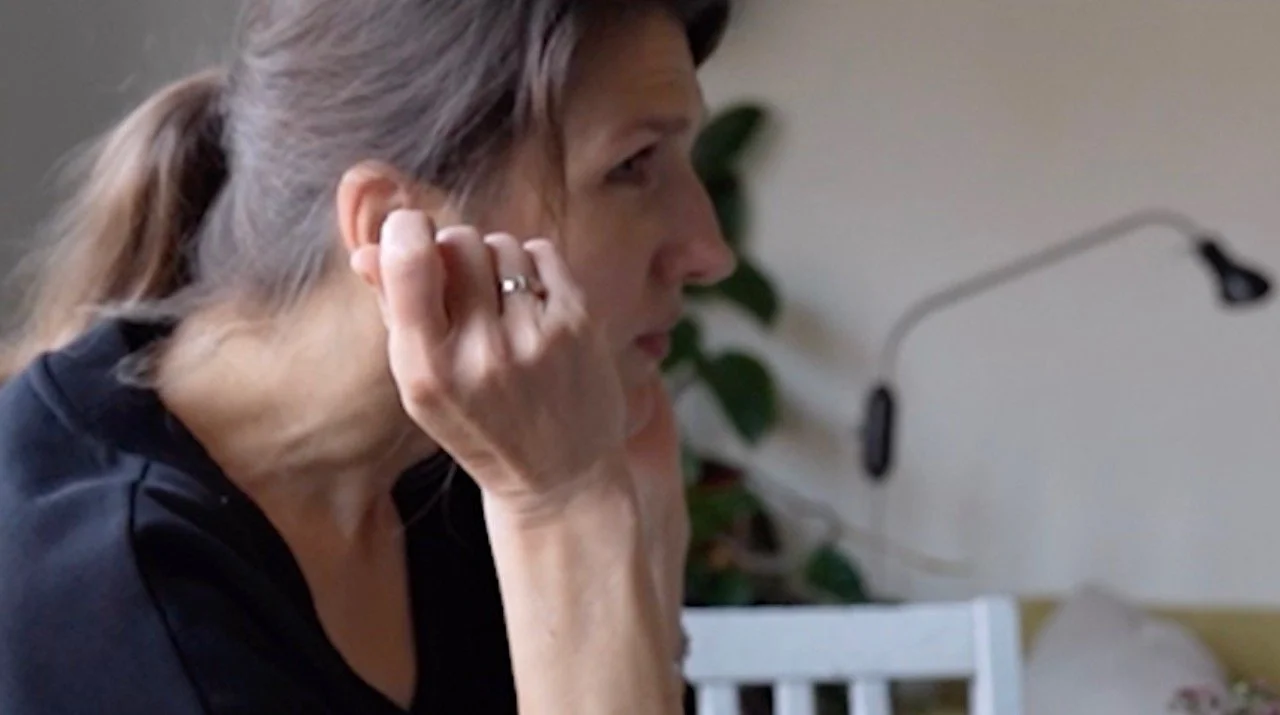
Still from Siri Hammarén’s Is to see, to see, look (2023). Courtesy of Siri Hammarén
Harstad Kino, screen 2.
Following the screening, the artist Siri Hammarén will engage in a conversation about her films with the curators of this programme; Tandi Reason Dahl and Johanne Edvarda.
The film program Doublet consists of four short films by Siri Hammarén, Patty Chang, and Gunvor Nelson. In their own distinct ways, the films explore how repetition and translation shape our language and our understanding of it. In the films, language moves between the meaning of words and their delivery.
The voice sometimes appears as something independent or external to the body – a kind of autonomous agent that has taken residence within us. Patty Chang’s Rather to Potenitalities, Part 1 (2009) features excerpts from films that were re-recorded to make them available in languages other than the film’s original language. These films take on a different character, yet the voice remains connected to the body to which it belongs.
Anyone who has tried to learn a new language knows it’s a challenging and vulnerable experience. You can feel like a different person. Speaking can be challenging – things can be misunderstood, or the words that come out of your mouth might come out wrong. On the other hand, teaching someone a language requires both patience and consideration. Translations and attempts to be understood are expressed through gestures around a table in Siri Hammarén’s Is to see, to see, look (2023).
Repetition can be used to emphasize something, but if the repetition is repeated several times, the content may end up seeming abstract or disappearing, as in Nelson’s My Name is Oona (1969) At other times, repetition can create ambivalent shifts between what is told and what is re-told in a different language. In Siri Hammarén’s film Du sagst, dass du auf der Party bleibst, weil es dir Spaß macht (You Say That You’re Staying at the Party Because You’re Having Fun) (2026), the voice is examined as a carrier of testimony. Translated and interpreted by the judicial system, the words drift away from the narrator and become an echo of the events being recounted.
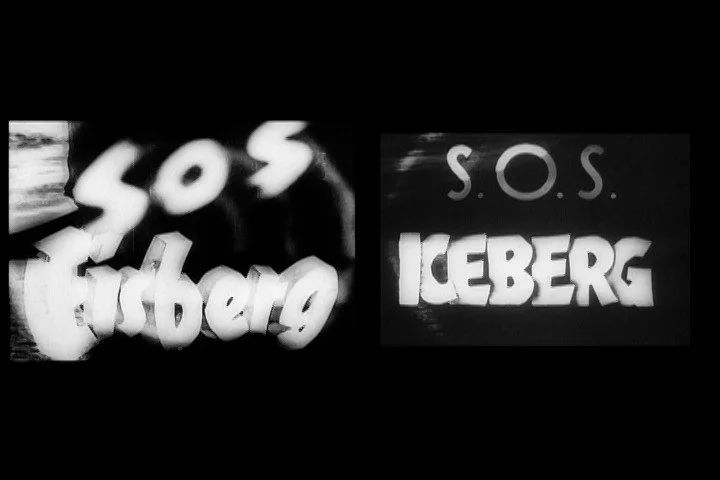
Patty Chang: Rather to Potentialities, Part 1 (2009, 2:47min). Courtesy of Patty Chang
Patty Chang: Rather to Potentialities, Part 1 (2009, 2:47min)
Patty Chang (1972) is a Los Angeles based artist and educator whose practice encompasses performance, video, and installation. Her work is held in the collections of institutions including the Museum of Modern Art (MoMA) and the Solomon R. Guggenheim Museum in New York, Fluentum in Berlin, and Moderna Museet in Stockholm. From the Fluentum Collection on Rather to Potentialities: Between 1928–33, after the invention of sound film but before the perfection of sound dubbing techniques, film studios made films in multiple languages for international distribution. Instead of voice dubbing, studios would successively re-film in each language, often with the same actors—this practice was known as body dubbing. Rather to Potentialities is a video based on the simultaneous viewing of multiple language version films. The source material comes from SOS Iceberg (English) and SOS Eisberg (German). Both film narratives deal with extreme landscapes and the western imaginaries of othered, unknown places. The act of reproducing through translation creates a stuttering echo effect of irresolution that is inherent in any performance that tries to replicate itself, but is unable to do so.
Still from Siri Hammarén’s Is to see, to see, look (2023). Courtesy of Siri Siri Hammarén
Siri Hammarén: Is to see, to see, look (2023, 8:53 minutes)
Two women live together without a shared language. In Is to see, to see, look the communication between the two women both fails and finds ways to go around its limits. Sensitive themes are being treated with big physical movements and sounds rather than words. Movements creates images for what otherwise is difficult to touch upon, in between translations. The work addresses the personal consequences of political displacement as well as limits and possibilities of language and of relating to one another. The rhythm; its gaps, repetitions and cuts (in image and edit) resonate with and build upon the particular grammar of the language between the two women.
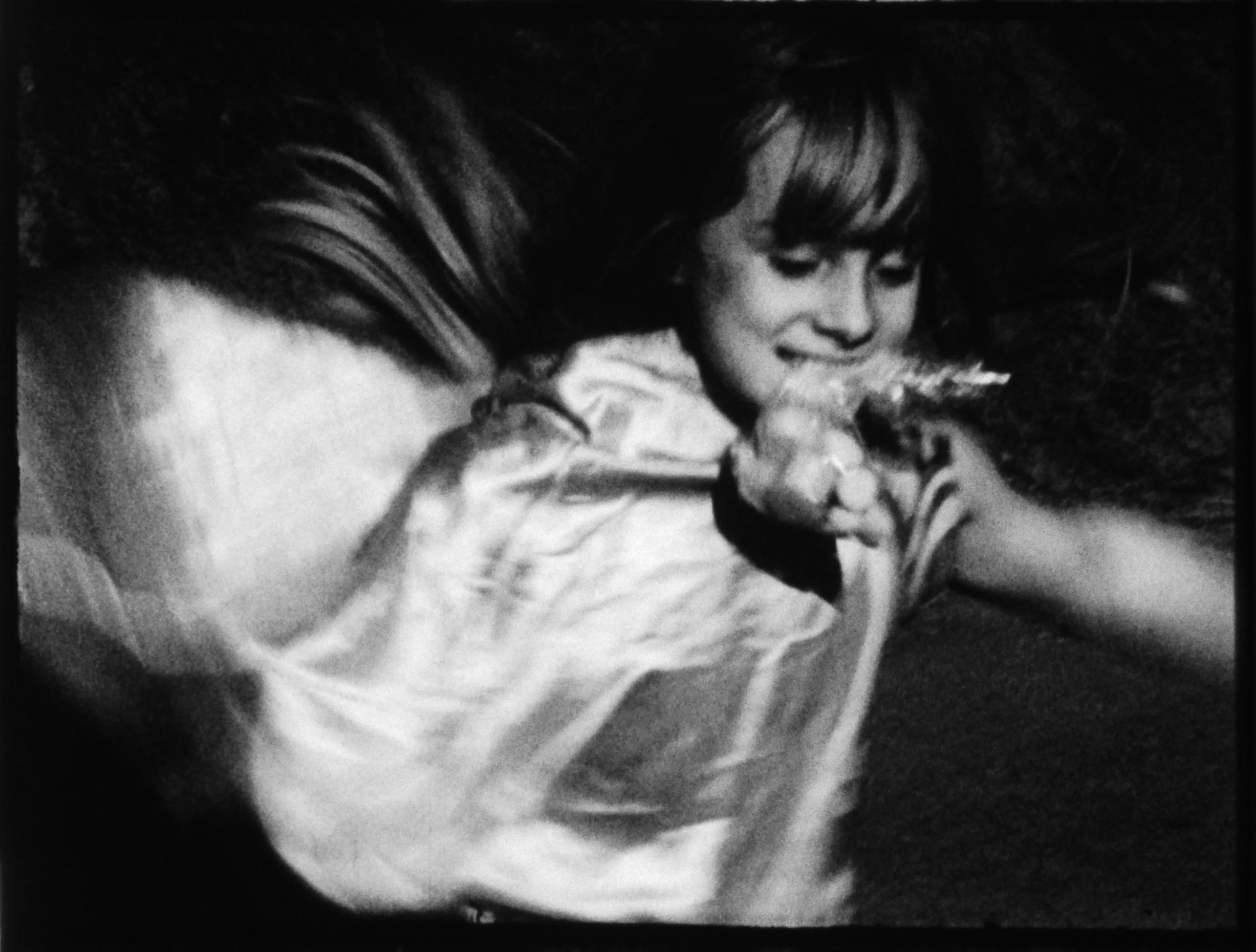
Gunvor Nelson, My Name is Oona (1969, 10 min). Courtesy of Filmform
Gunvor Nelson: My Name is Oona (1969, 9:38 min)
Gunvor Nelson (1931–2025) was a Swedish artist who moved to the United States in the 1950s and became part of the American avant-garde film movement. Nelson started out as a painter, but film and video eventually became her primary medium. She also taught film to students at the San Francisco Art Institute. Often, Nelson turns her camera towards her immediate and intimate surroundings, and sound, image, and editing are interwoven in unexpected ways. As for instance in My Name is Oona, where Nelson captures her own daughter repeating her own name. John Sundholm, a professor of film studies at Stockholm University, says the following about the film: “My Name is Oona was Nelson’s final breakthrough on the American avant-garde film scene. The sound consists of Nelson’s daughter, Oona, repeating the names of the days of the week and of her saying “my name is Oona”. The latter is edited into an expressive rhythmical structure that accompanies the visual structure of the film that plunges into the experience of a child where both bliss and fear reigns. As so often in Nelson’s oeuvre there is a female subtext too: it is male voices that executes their authority upon Oona, whereas as a girl she is still equal to boys of her own age.”
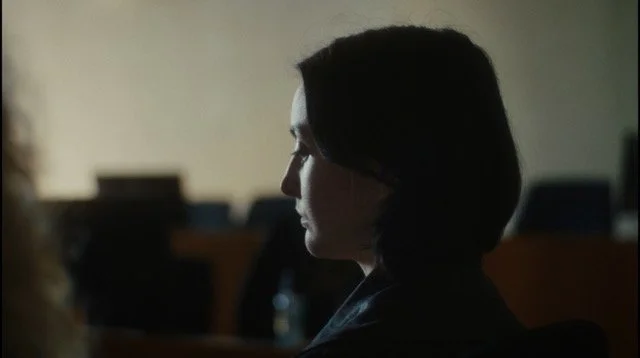
Siri Hammarén: Du sagst, dass du auf der Party bleibst, weil es dir Spaß macht (2026, 27:45 min). Courtesy of Siri Hammarén
Siri Hammarén: Du sagst, dass du auf der Party bleibst, weil es dir Spaß macht (You Say That You’re Staying at the Party Because You’re Having Fun) (2026, 27:45 min)
Siri Hammarén (1999) completed her bachelor degree in Fine Arts at Malmö Art Academy, Sweden in 2024. Since then she has been studying film at HFBK Hamburg as well as at Städelschule, Frankfurt am Main.
A man is washing the staircase. A party is being retold in a court. Du sagst, dass du auf der Party bleibst, weil es dir Spaß macht explores the retelling of a sexual assault through institutional and linguistic filters. In a Danish courtroom, a young woman hears her own testimony spoken by a judge and translated by an interpreter – her story returning to her through two languages and two voices. Du sagst, dass du auf der Party bleibst, weil es dir Spaß macht engages with trauma not by visualizing the violence, but by showing the slow, procedural aftermath – the translation of experience into language. Told in the present tense and second person, the film allows us to inhabit the young woman’s perspective while also emphasizing the alienation of having one’s own story returned through others.